Best Pottery Wheel for Beginners: How to Pick a Real Starter Wheel
A pottery wheel you can actually learn on, not the one you wish you had. Here's what to look for, what to skip, and the wheel sizes that fit a beginner.
Disclosure: This post may contain affiliate links. If you buy through these links, PotteryKey may earn a commission at no extra cost to you. As an Amazon Associate, PotteryKey earns from qualifying purchases.
Buying your first pottery wheel is a bigger decision than it looks. A wheel is a piece of furniture that hums, vibrates, and lives in your house for years. Get the right one and pottery becomes a calming, repeatable habit. Get the wrong one and you spend half your studio time fighting the wheel instead of centering clay.
This guide is for first-time buyers who want a wheel they can actually learn on, not the one they wish they had after a year of practice. We will cover what to look for, what to skip, the price ranges that make sense, and how to match a wheel to your space. If you are still deciding whether you want a wheel at all, our guide to buying your first pottery wheel walks through the decision from a different angle.
Quick answer: best pottery wheel for beginners
If you want a short version, here is what we would actually buy today for a beginner, organized by budget.
- Best under $250: a compact electric wheel with a brushless or quiet brushed motor, 10 inch wheel head, and a sturdy base. Browse beginner pottery wheels on Amazon.
- Best $250 to $500: a mid-size wheel with a smoother motor, a foot pedal for speed control, and a removable splash pan. Browse pottery wheels in the $250 to $500 range.
- Best $500 to $900: a wheel with higher torque, a metal body, and a quiet enough motor for apartment use. Browse quiet pottery wheels for apartments.
- Skip until later: wheels marketed as professional or studio-grade unless you already have a year of throwing under your belt.
You can also browse a broader pottery wheel selection to see the full range of starter options.
What actually matters in a beginner pottery wheel
Six things matter more than the others, and the rest is mostly preference or future-you problems. A wheel that gets these right will take you through your first year of throwing without complaint.
1. Stability over speed
Speed feels exciting in product photos, but stability is what keeps clay on the wheel head. A wheel that wobbles at low speed will throw you off balance the moment you put your hands on the clay. Look for a heavy base, low center of gravity, and rubber or adjustable feet. A wobbly wheel is the number one reason beginners give up on centering.
2. Quiet enough for your space
A noisy wheel is fine in a detached garage. It is not fine in an apartment at 9pm. If you are throwing in shared space, look for a brushless DC motor or a wheel specifically marketed as quiet. A quiet pottery wheel is the difference between a hobby you can do after work and a hobby your neighbors will eventually complain about.
3. Foot pedal speed control
Some beginner wheels have a knob instead of a foot pedal. A knob works, but you will find yourself reaching for it with a wet, clay-covered hand. A foot pedal lets you keep both hands on the clay and adjust speed without breaking your flow. If the wheel you want only has a knob, that is a real reason to look at a different model.
4. Wheel head size between 9 and 12 inches
A 10 inch head is the most versatile for mugs, small bowls, cylinders, and most beginner projects. Anything under 9 inches limits what you can throw. Anything over 12 inches makes centering harder for a new potter. If you are shopping for a small-space wheel, see our beginner pottery kit guide for non-wheel options that work on a kitchen table.
5. Removable splash pan
Throwing is messy. A removable splash pan is the difference between cleaning up in 5 minutes and cleaning up in 45. Almost every wheel in the $300+ range includes one. The cheapest wheels often do not, and that is a good reason to spend a little more.
6. Power, not peak power
Ignore the peak wattage in product copy. What matters is whether the wheel has enough torque to keep turning when your hands are pressing on the clay. A wheel that slows down the moment you lean on it makes centering impossible. Mid-range wheels almost all handle this. Cheap wheels often do not.
The price tiers, honestly
Wheels cluster into three practical tiers, and each one teaches you something different.
Under $250: starter wheels
These work for learning the absolute basics. Most of them have a plastic or thin metal body, a small motor, and minimal features. The good ones are quiet enough for a small apartment. The bad ones wobble, run loud, or lack the torque to center a basic ball of clay. A starter wheel in this range is fine for the first month or two, after which you will know whether you want to invest in something better.
$250 to $600: the actual sweet spot
This is where the best beginner wheels live. The motor is usually smoother, the body is heavier and more stable, and the wheel has the small features that matter, like a removable splash pan, a foot pedal, and reverse direction. A wheel in this range will keep you happy for the first year and well into the second, especially if you commit to throwing regularly. Browse studio-grade beginner pottery wheels to see the upper end of this range.
$600 to $1,200: enthusiast wheels
Once you are throwing weekly, want to make larger pieces, or want a wheel quiet enough to live in your living room, this is the range. You will see metal bodies, brushless motors, and wheels that can handle 25 pounds of clay. They are excellent, but they are overkill for the first six months.
What to skip at the start
A few things look great in product photos but get in the way of learning.
- Mini pottery wheels marketed for kids. They are toys. They will not center a basic ball of clay and they will frustrate an adult learner within an hour.
- Wheels with plastic wheel heads. A plastic head warps over time and throws off centering. Look for metal or at least a thick composite head.
- Anything that promises a turntable, painting wheel, or pottery kit in one. These are usually bad at both jobs. A real wheel and a separate tools kit will out-perform a combo every time.
- Wheels without a clear return policy. Buy from a retailer that lets you return the wheel if the motor is louder than you expected or the body wobbles. The spec sheet is not the wheel.
Setting up the wheel
Where you put the wheel matters as much as which one you buy. A few quick rules:
- Use a sturdy table. A kitchen table on a flat floor is fine. A flimsy desk is not. The wheel will transfer vibration to anything it sits on.
- Keep the wheel near a water source. You will go through a surprising amount of water. A bathroom, kitchen, or garage sink nearby saves a lot of carrying.
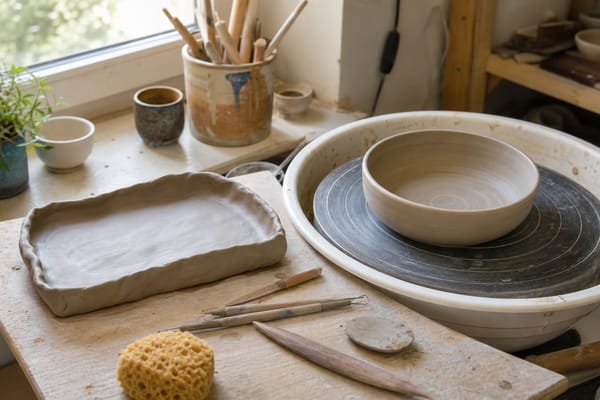
- Plan for splash. Clay water will go further than you think. A wipeable floor or a small rug under the table saves cleanup time.
- Sit at the right height. Your forearms should be roughly parallel to the floor when your hands are on the wheel head. A too-high table causes shoulder pain. A too-low table causes back pain. A simple adjustable stool fixes most of this.
The first week on the wheel
Most first-time throwers go through the same arc.
- Day 1: clay flies off the wheel head, the floor, and you. This is normal.
- Day 2 to 3: you can center a ball of clay, but it leans. This is also normal.
- Day 4 to 7: you can open a small well, pull a thin wall, and make a small cylinder.
- End of week 2: a real mug. Possibly a lopsided one, but a real mug.
Keep clay costs low during the first month. Most studios sell reclaimed clay for a fraction of new clay cost, and a 25 pound bag of practice clay will last a typical beginner about a month of twice-weekly sessions. Browse pottery clay for beginners if you are buying your own.
Wheel and tools that go together
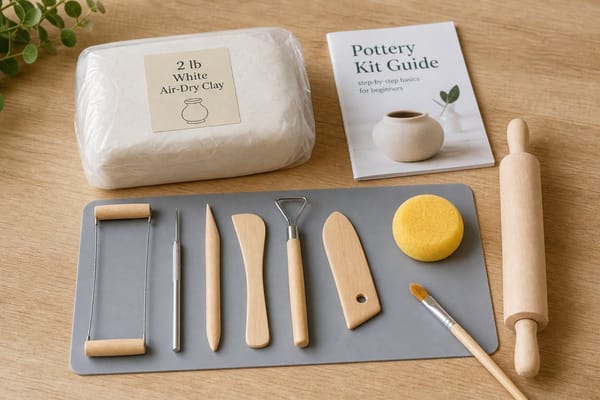
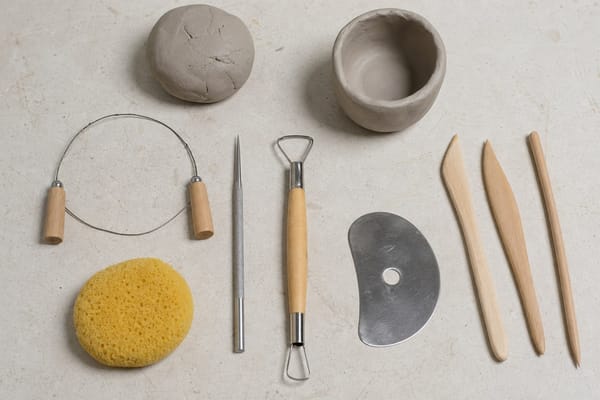
You do not need much to start, but a few tools will make the first month much easier. Our beginner pottery tools guide covers the full kit. The short version is: a wire clay cutter, a needle tool, a rib or scraper, a sponge, and a small bucket of water. Most wheels do not include any of these.
When to upgrade the wheel
A few signs you have outgrown your first wheel:
- You are throwing consistently and want to make pieces larger than 8 inches tall.
- The motor is starting to strain under the weight of your clay.
- You are spending more time cleaning the splash pan than throwing.
- You are dreaming about a metal-body, brushless motor wheel.
Until then, save the upgrade budget for clay, glazes, and a class or two. The wheel is the most expensive piece of equipment in pottery, and the most expensive wheel is not the one that teaches you the most.
Frequently asked questions
How much should I spend on a beginner pottery wheel?
Most first wheels land in the $200 to $600 range. Spending more than $1,000 on a first wheel rarely makes sense. The right price is the cheapest wheel that is stable, quiet, and has enough torque to center a basic ball of clay.
What size pottery wheel do beginners need?
A 10 inch wheel head is the most versatile for mugs, small bowls, cylinders, and most beginner projects. Anything smaller limits what you can throw. Anything larger makes centering harder.
Can I learn pottery without a wheel?
Yes. Pinch pots, coil pots, and slab work do not need a wheel at all, and a basic hand-building kit runs $20 to $60. See our guide to beginner pottery kits for non-wheel options.
Are cheap pottery wheels worth it?
A few are, mostly the ones that focus on stability and a smooth motor. The cheapest wheels tend to wobble, run loud, or lack the torque to center clay. The sweet spot for value is usually $250 to $450.
Do I need a wheel to take a class?
No. Most studios provide wheels during class. Take a class or two first to find out whether wheel throwing is what you want to do at home before you buy.
Choosing your first pottery wheel is less about specs and more about space, budget, and how often you expect to throw. A stable, quiet wheel in the $250 to $500 range will serve most beginners well for the first year or more. Spend the saved money on a basic tools kit, a few bags of practice clay, and a class or two to get the most out of whatever you buy.